One page
Reasoning ruler
Simulation
Hallucination and persuasion scales: in calibration. Judge hand-off: in build.
AIM on one page.
What Adaptive Intelligent Measurement evaluates, what it costs, what has passed its gate and what has not yet. If your evaluator sent you this, here is the short version. Every line is on the site with its status.
The question behind an eval bill.
If a score moves and no one can say why, the release waits or ships on a guess. That cost is yours to name. This page shows what AIM can settle today.
What it is.
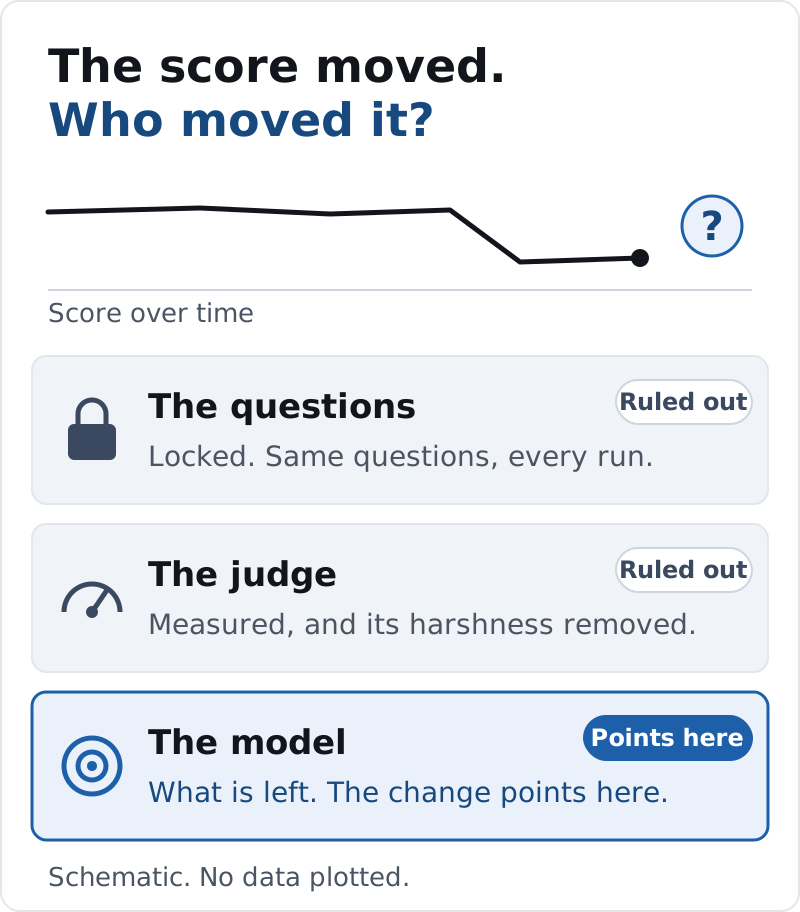
A score can change because the model changed, the judge changed, or the questions changed. AIM measures the judge and locks the questions. What is left points at the model.
Simulation
Set to an error bar of 0.20. Delivered at 0.21 once judge harshness is corrected at each level.
Simulation: 15,000 decisions on judge data from our own runs, seed 20260908. With harshness left in, the same run came in at 1.16. Error bars in logits.
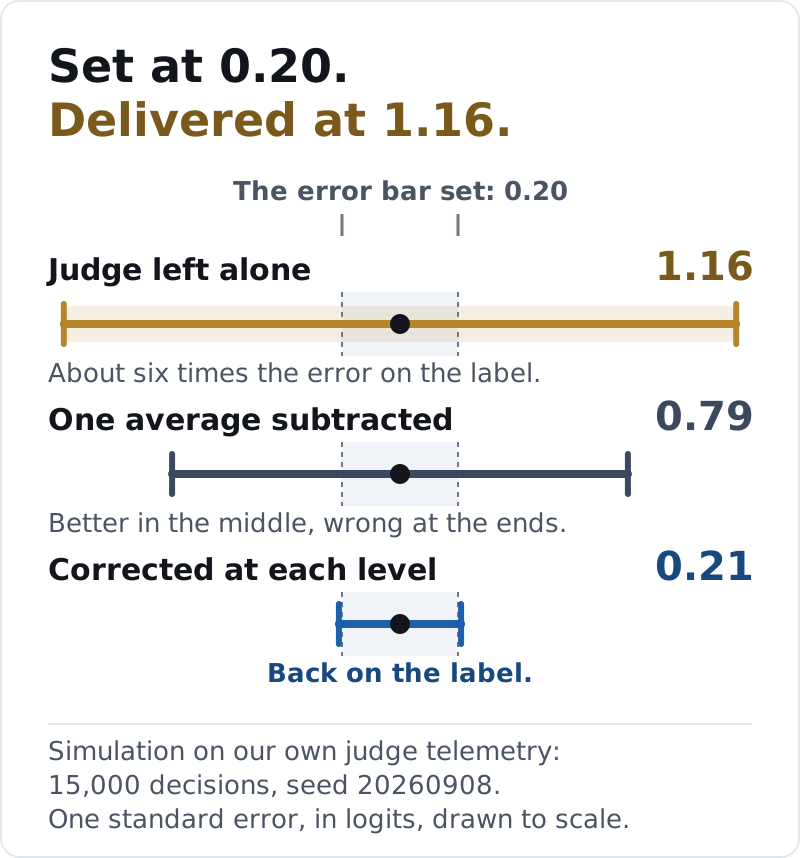
Simulation on judge telemetry from our own runs. The 0.07 above is one judge's gate record of 2026-08-22, unit one judgment; these error bars are a different run, in logits.
What it changes.
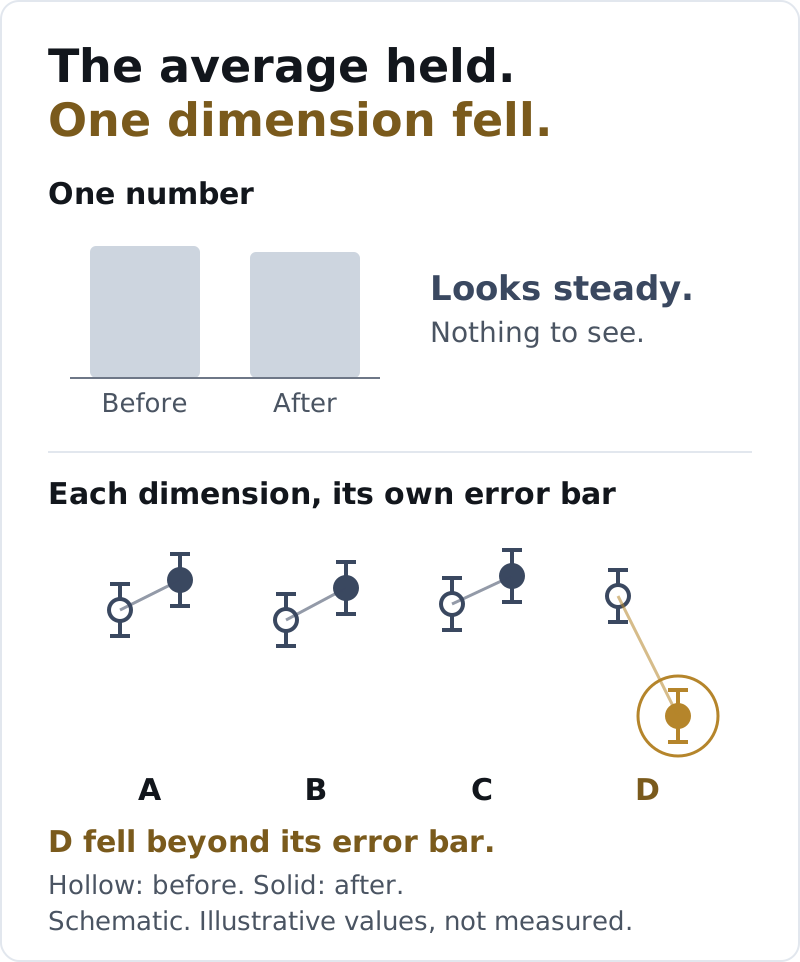
If your metrics do not move together, an average can hide the one that fell. Each dimension keeps its own error bar, so the one that fell stays visible.
In build.
What it costs.
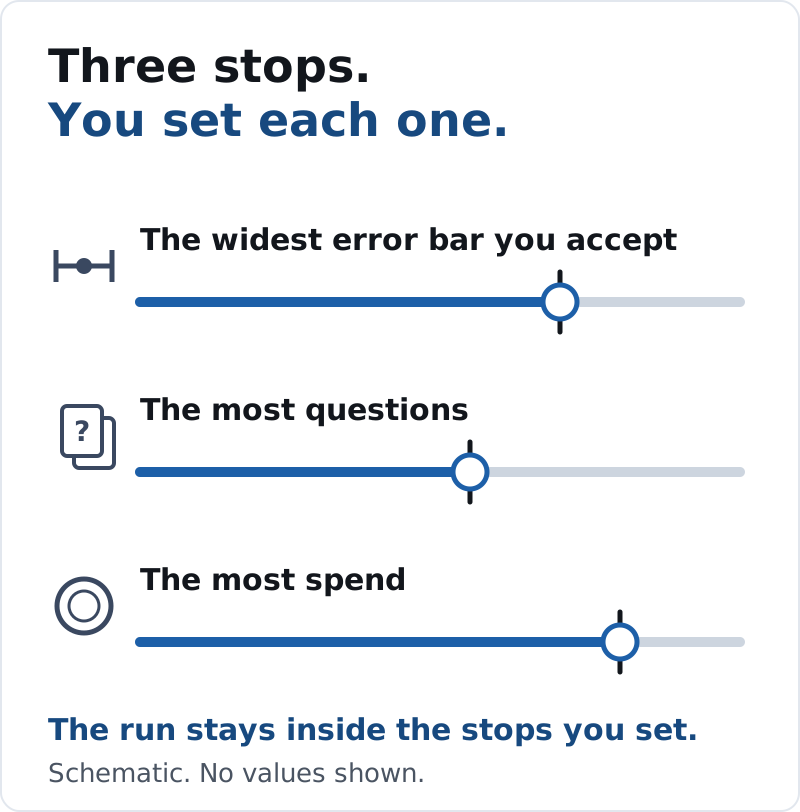
If the evaluation bill gets argued, the stops are yours to set. The widest error bar you accept. The most questions. The most spend.
You set these stops on every scoped engagement. Automatic routing between judges is in build. Each fee is set on a 20-minute scoping call; see how buying works on the Pricing page.
What has passed, and what has not yet.
- The reasoning ruler: Simulation.
- Hallucination and persuasion scales: gate not yet passed.
- Judge hand-off and stops: in build.
- Per-dimension profile: in build.
- The same model measured on two dates: not yet shown.
- Ruler stability over months, and a validity study: not yet shown.
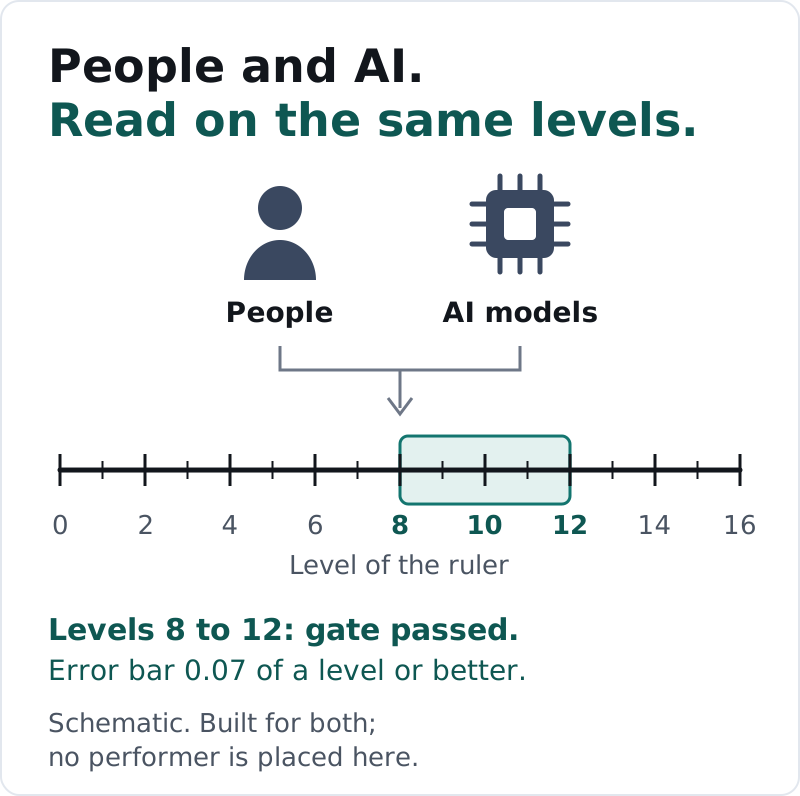
The precision gate passed for the reasoning ruler. It does not cover people: no person has been placed on it yet.
What we will not claim.
AIM implements at measurement grade the latent-trait/GLMM approach that NIST AI 800-3 highlights as a promising foundation for AI evaluation statistics. AIM is not a NIST standard. It claims no endorsement.
- No customer names yet.
- We do not publish a cost of getting this wrong. We have not measured yours.
- No claim about your own prompts or your own task mix.



Every judge bends the picture. AIM undoes the bends it can measure and stops using a judge where it cannot. Illustration, an analogy. Painting: Leonardo da Vinci, Mona Lisa, public-domain scan (C2RMF) via Wikimedia Commons.
What it takes to run.
- Where the data goes. Hosted plans run on our servers. The self-hosted harness keeps your data on your side.
- What your engineer has to run. To be confirmed.
- Support contact and response time. To be confirmed.
What happens next.
Watch a recorded session together. Then talk to us about a proof engagement on your hardest case.
Email matt@xlnc.co to set up the call.