Your AI score moved. Can you defend it?
When a validator, a governance council or a customer's reviewer asks how sure you are, an unmeasured judge can turn one score into a finding, a delay or the wrong model in production. AIM measures the judge, locks the questions and puts an error bar on every measure.
Your score moved. What moved it?
Method published in peer-reviewed venues since 2016. Read the open-access chapter.
Simulation
Set to an error bar of 0.20. Delivered at 0.21 once judge harshness is corrected at each level.
Simulation: 15,000 decisions on judge data from our own runs, seed 20260908. With harshness left in, the same run came in at 1.16. Error bars in logits.
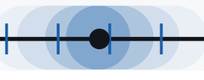
Final read after 139 questions: measured level 12.40, error bar 0.153 logits (one standard error).
AIM measures the judge and locks the questions. A move bigger than its error bar points at the model. Band: a recorded session on a scripted test performer, 139 locked questions, 2026-08-27.
Judge measured. Questions locked.
Judges drift. In one published study, GPT-4's accuracy at telling prime from composite numbers fell from 84% to 51% between March and June 2023 (Chen, Zaharia and Zou, 2024).
In a simulation on judge telemetry from our own runs, a run set to a standard error of 0.20 came in at 1.16 with judge harshness left in. With it corrected, 0.21. Modeled1
Simulation.



Measured, not averaged.
Each level carries its own error bar. No average sits on top, so a failure at one level stays visible.
Pick any score. It resolves to one question in a locked question set, with its answer key and a fingerprint.
One of our gates failed. A 200-question wave failed the test for one shared dimension. We published it as a finding.
The simulation behind the 0.21, in the whitepaper
If your domain is not on the list, we say so before the run.
Re-measured, and one outside view.
We re-measured three LLM judges on the same calibration items in a second paid run: Qwen3 235B Instruct (qwen3-235b-a22b-instruct-2507), DeepSeek V4.1 Flash (deepseek-v4-1-flash) and TypeSafe (Jev).
No judge moved more than 0.01 logit (DeepSeek +0.005, Qwen3 +0.007, TypeSafe -0.001; standard error about 0.03). Against a margin of plus or minus 0.10 logit set before the run, that drift counts as zero.
Limit: These judges ran at temperature 0, so much of this stability reflects near-deterministic model output; the figures describe LLM judge stability on a fixed item bank at stage-level grain, not the reliability of scores for people. Whether it holds over months is the next test. It is not done yet.
The re-measurement run, on the Judges page

“I've always stressed the importance of ethics in persuasion, and Dr. Matt Barney's AI [measurement] tool brings unprecedented scientific rigor to this domain. I am optimistic that his method holds immense promise in proactively preventing the misuse of persuasion techniques, both by people and emerging technologies, and augmenting their long-term use correctly”

Two questions to ask any ruler.
Think of a physical gauge you trust. It is traced to a standard and states its error. Those are the two checks to ask of any ruler.
Has the ruler moved?
The question set is frozen, fingerprinted and dated. Every run checks the fingerprint before it starts.
Re-measurement run: published.
Is the ruler circular?
Each level is fixed before any answer is graded. New questions stay sealed, so no model could have learned them. For new questions, the writer, the attacker and the judges come from separate companies. Each judge is checked against the others.
We are still credentialing judges for levels 7 to 13. Each one is published with its level, its error and how to use it.
A check against outside human experts: still ahead. See the roster.
Fingerprints checked at the start of every run.2
Know the cheapest judge that can.
Each credentialed judge has a published ceiling. Today you pick the judge and see how far up the ruler it grades reliably. The run stops when the error bar is tight enough, or at the question limit you set. Hand-off to a stronger judge is in build.
The cheapest capable judge starts. A stronger judge waits on stand-by, in build. Stops you set: the widest error bar, the most questions, the most spend.3
In build.
Open to reviewers. Closed to training.
- Engine
- Open to reviewers under Apache-2.0, so they can check the method.
- Question banks
- Closed, so the questions stay out of public training data. Each bank has a sha256 fingerprint.
If you run an eval loop, AIM is one step in it. It replaces nothing you built.
Works with your eval stack
Keep the tools you already use. XLNC adds what they leave out: how harsh or lenient each judge is, and how sure you can be of the score.
Bring your results


Planned




Logos show compatibility only. They belong to their owners; we have no partnership with or endorsement from them.
- Call us as a judge.
- Any MCP client, such as Claude Code or Claude Desktop, can call our scoring tool. You send judge ratings and get back a score corrected for each judge's severity, with a 95 percent interval, not a bare number.
- Bring your results.
- We can read result files exported from promptfoo, LangSmith, OpenAI Evals, or a plain CSV, and map them into one common format.
- Gate on it.
- Use the interval in your release gate so one lucky run does not ship.
What works today: our demo scores performers on our MHC scale and our persuasion scale. The MCP scoring tool works today for one calibrated construct, using judge severities we have already measured, so it cannot yet estimate the severity of a judge you bring. File reading works today for promptfoo, LangSmith, OpenAI Evals and CSV.
Planned, not yet available: scoring straight from an uploaded file, scoring through our REST API, the MHC and persuasion scales through the MCP tool, and connections to Inspect AI, Eval Conductor and Anthropic's evaluation tools. We name these tools to describe compatibility only; we have no partnership with their makers.
No score without its error bar.
That is the standard we hold every number here to. Each of our own measures names its status beside it. Today each is still in calibration.
Free to copy: the rule we use to decide if a judge's score counts. One paragraph. No form. Read the rule
Tell us which number you do not trust.
You will get a short note from Matt when a measurement slot opens. Nothing else, no drip sequence.
We store what you send with the few providers our Privacy Policy names, and use it to reply to you. We do not sell it. Email matt@xlnc.co and we delete it. Read our Privacy Policy.
- Ceiling rule met. Criterion: a judge's ceiling is the highest level it passes before a break, capped at 13; passes above a break do not count, and the level-14 questions are exploratory and never set a ceiling. Unit: one judgment on one offered question. Source: the reasoning-ceiling probe run of 2026-08-19, checked by our internal quality review.
- The simulation used 15,000 judge decisions, dated 2026-09-09. Method and results are in the whitepaper. Modeled Whitepaper
- Fifteen artifacts sit under sha256 fingerprints, checked at the start of every run.
- Published judge ceilings sit at level 11, with a stated condition. Ceiling rule met
- Method: Chapter 3 of a book on models and metrology, by Barney and Barney. Edited by Fisher and Pendrill, a former Chair of EURAMET. Published by De Gruyter in 2024, pages 103 to 132. doi.org/10.1515/9783111036496-003