MEASUREMENT SCALE 1
How much complexity a performer, human or AI, can actually sustain.
When you are about to trust a model with work that has real structure, you need to know how much complexity it can actually sustain, not how it did on a quiz. This scale measures the developmental order of hierarchical complexity a performer, human or AI, can sustain: the flagship ruler every other AIM scale re-anchors onto. It does not measure knowledge, style, or speed; a fluent wrong answer at a low stage is still a low-stage answer. A benchmark can tell you two models tied on a test form. This ruler tells you where each one sits on the complexity order, with the standard error stated at every band. Frozen bank, audit-ready.
Boundary. It does not measure knowledge, style, or speed; a fluent wrong answer at a low stage is still a low-stage answer.
Decision context. Feeds capability sufficiency, model selection, and work redesign decisions (the three-decisions block on the Science page).
Rasch family measurement model; calibrated item bank, pre-registered on OSF, anchored to human data.
Measurement frame. Units are logits on the MHC complexity order, with certified stage-boundary pins. A one-logit difference is a constant odds ratio everywhere on the ruler: intervals mean the same amount at every stage.
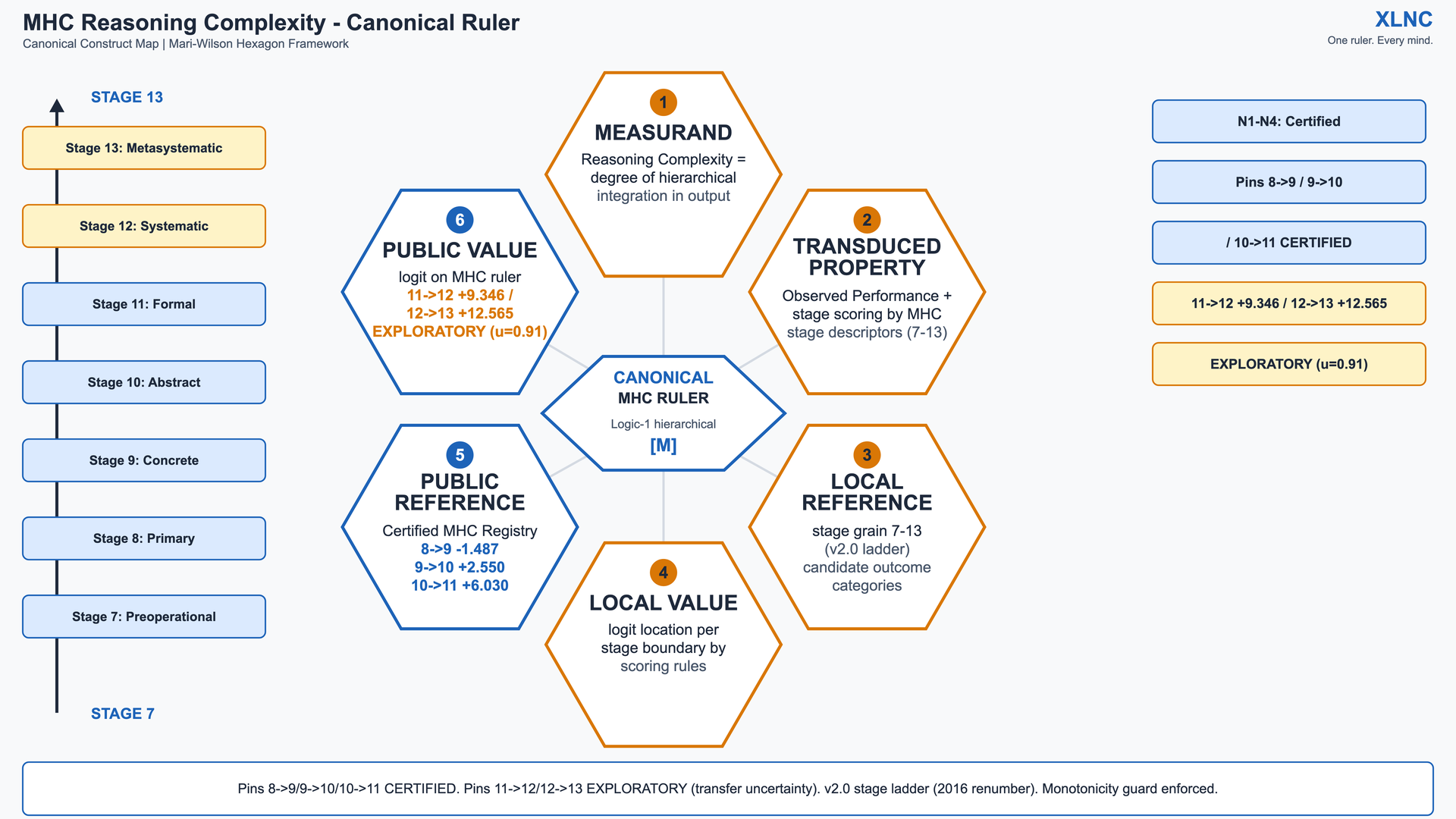
Every published measurement carries a stated standard error, stated per band, never as a single scale-wide average. Averages hide the floor.
| Band | Band label | Standard error | Certification implication |
|---|---|---|---|
| All published bands | Certified measurement-method standard | SE 0.07 | CERTIFIED at SE 0.07 for the canonical MHC ruler (science.html, SE 0.07 standard card). |
| -- | BELOW FLOOR Per-band judge-evidence readout Model rows whose band severity SE exceeds the frozen quality floor render on the Science page select-ruler, flagged, never presented as a pick. | -- | Shown and flagged, never removed. |
| -- | NO EVIDENCE Per-band no-evidence models A model with no per-band judge evidence at a band is listed under no evidence, never silently dropped. Both row classes render on the Science page select-ruler readout. | -- | Shown and flagged, never removed. |
Canonical: frozen bank, audit-ready.
Tier as of vintage 2026-09-01. Tier changes are events; the promotion rules for WATCH scales are stated in the canonical scale-priority record.
Rows that fail the floor or lack evidence are shown and flagged, never removed.
The flagged rows below are fixtures standing in for the live select-ruler readout; the rendered rows with real model names are on the Science page.
The flagged rows render in the S3 table above with the shared .below-floor and .no-evidence classes, the same flagged treatment as the model-ratings readouts. Dropping a failing row is a defect class, not a style choice.
Status. Live in the demo.
POST a response set against the MHC bank; receive a band location on the complexity order with the standard error stated at the value.
POST /score  {"scale": "mhc", "responses": [...]}
{"band": "S11", "location_logit": "<stated>", "se": "<stated at the value>"}
Rate and pricing tier per the pricing page; certification tier carries SE 0.10.
The full API reference lives on the docs surface when it is funded (IA spec section 4); until then this block is the usage detail of record.