We differentiate silently. Each block below states what XLNC holds that the category does not, in buyer-legible language, with no competitor names.
One calibrated ruler measures every performer: human, AI agent, robot. One interval-scale metric. Stated uncertainty.
Most evaluation tools report scores. Scores are not measurements. A measurement carries a unit, a scale, and a stated uncertainty. XLNC was built as an instrument, not a leaderboard. The difference shows in four places.
D1. Metrological traceability. Every measurement on the XLNC platform traces to certified anchors on the AIM ruler. Results are comparable across models, across time, and across teams, because they are tied to a fixed reference rather than to a shifting benchmark. (CERTIFIED)
D2. Rasch conjoint measurement. XLNC applies a unidimensional Rasch hallucination construct, converting ordinal judge outputs into a true interval scale. Distances between capability levels mean the same thing everywhere on the scale. Raw benchmark scores do not have this property. (CERTIFIED)
D3. SE 0.07 standard. Every XLNC result ships with its standard error. Our current standard is SE 0.07 on the AIM ruler, achieved and publishable. When a number carries its own uncertainty, decisions rest on evidence, not on false precision. (CERTIFIED)
D4. Judge-panel self-consistency. Single-judge scoring hides rater drift. XLNC uses a calibrated MFRM judge panel, checked for self-consistency before any score is released. The panel is an instrument component, measured and maintained like one. (CERTIFIED)
This is not a feature list. It is the difference between ranking systems and measuring them. NIST AI 800-3 states it plainly: "the intervals between LLM capabilities on the latent scale have meaning independent of the difficulties of the specific tasks selected into the benchmark. Raw benchmark scores do not have this property."
XLNC delivers that property by construction. The same ruler extends to human performers, AI agents, and robots, so capability claims become commensurable across all of them. Published work in the Cambridge Handbook, Chapter 18, documents our unobtrusive measurement approach, and the Coaching Supervision stack is fully Rasch-analyzed. (CERTIFIED)
Every measurement traces to certified anchors. The ruler is calibrated, not crowd-sourced.
A true interval scale, so differences between performers are meaningful numbers, not ranks.
Honest uncertainty, stated on every published score. No point estimates without error bars.
A self-consistent many-facet Rasch panel, so judge severity is modeled and removed.
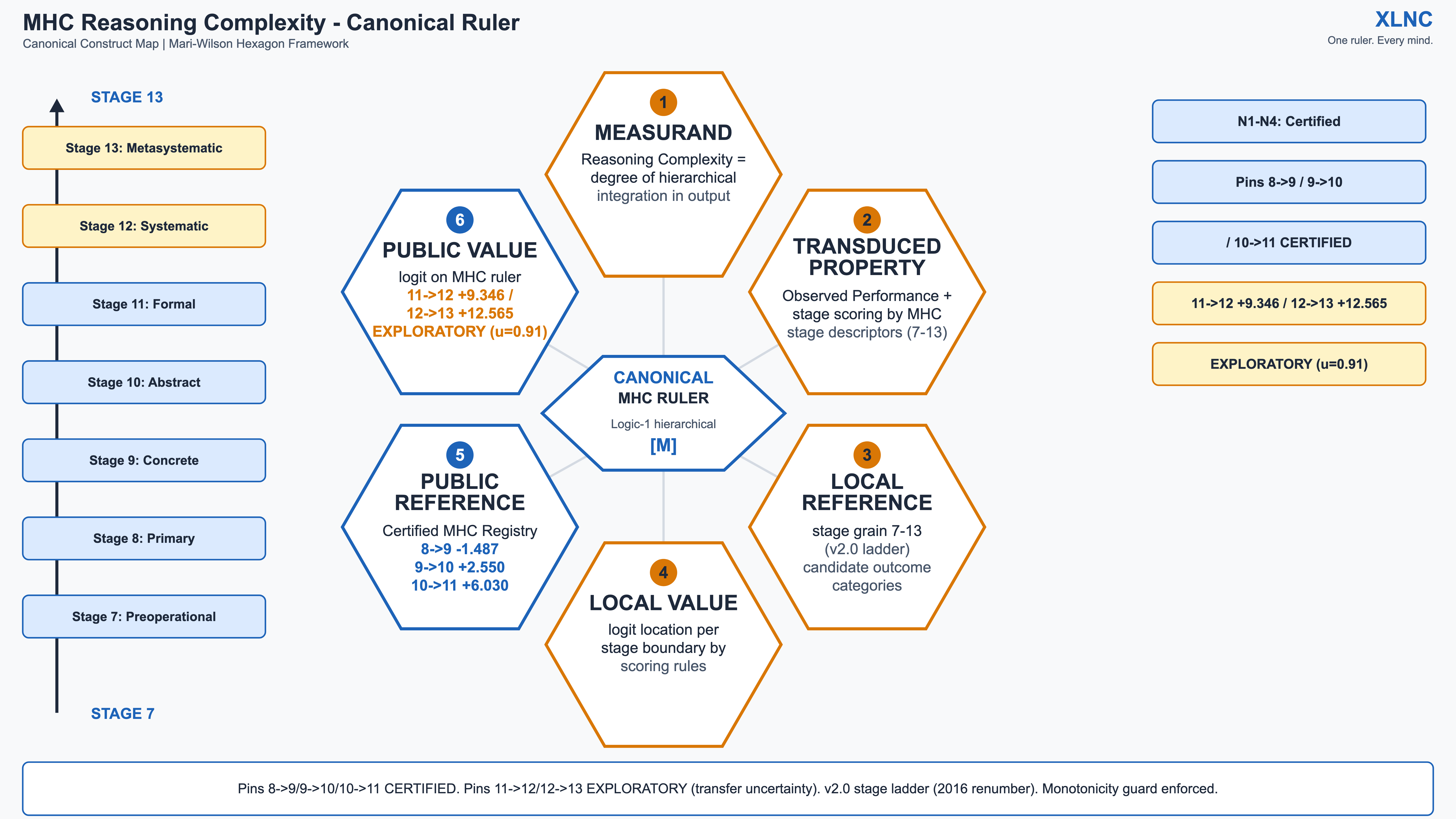
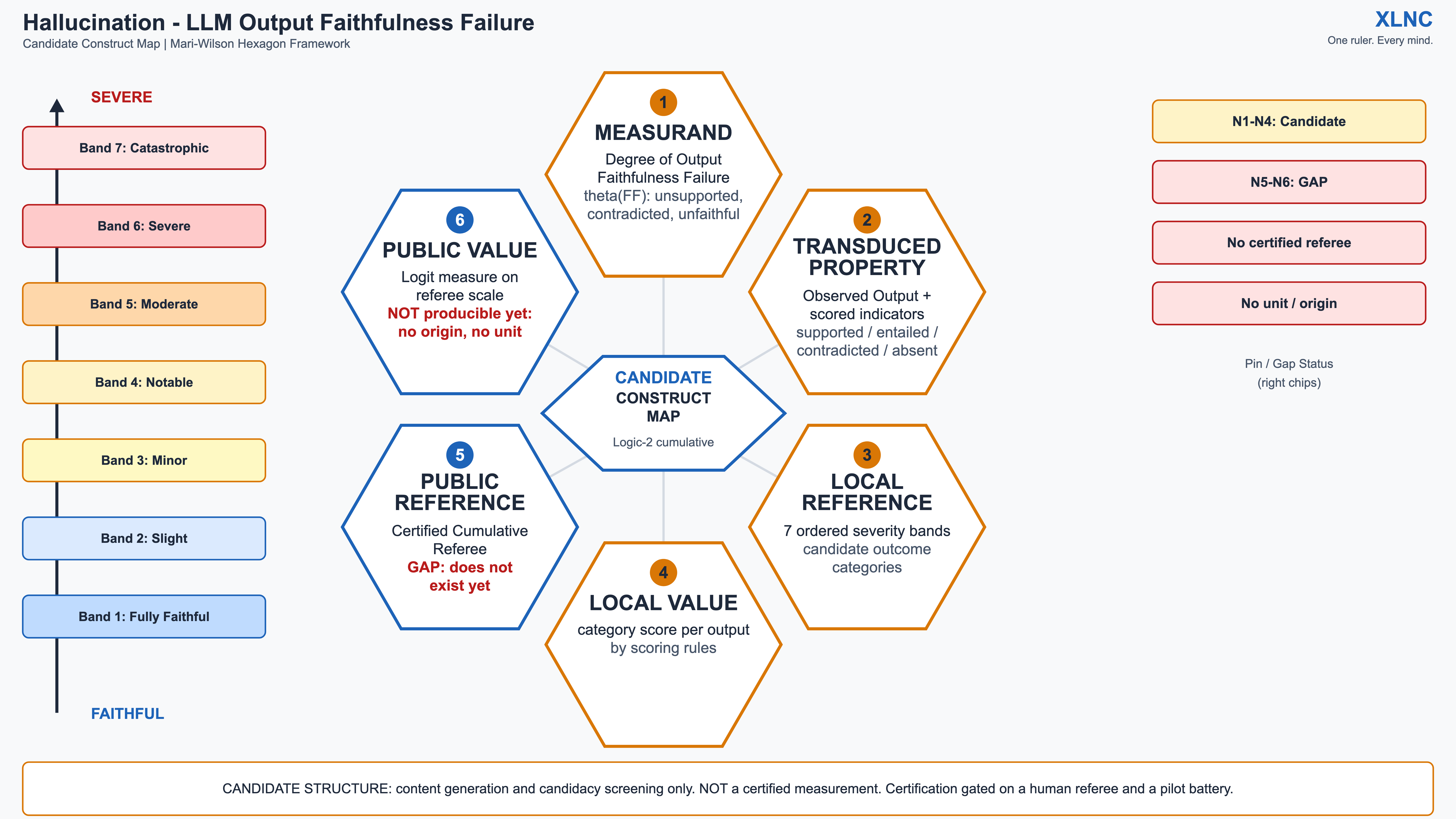
MHC reasoning complexity and the unidimensional Rasch hallucination construct. Same certified assets, full column width.